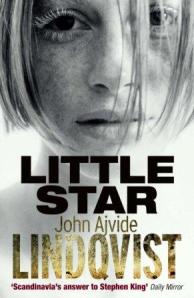
Little Star by John Ajvide Lindqvist

Reproduced with kind permission of Quercus Publishing

I love Lindqvist’s work and would go as far to say he is my favourite horror writer, so I was really looking forward to reading this. And it’s terrifying. Truly. If you don’t like gore and visceral scares there are definitely some scenes to skip, but the storyline is intriguing and the characters alluring in all their nastiness.

A jaded musician rescues an abandoned baby, who displays no normal infant behaviour at all but can sing in perfect pitch. He and his wife raise her in isolation in the cellar, worried that the outside world will corrupt her beautiful gift; the stories that he tells her as she grows, that the world is full of big people that want to eat little people like her, will come to have terrifying consequences as the child, Theres, eventually emerges from her prison. Lindqvist’s cutting satire on reality television and the Facebook generation collides with the suppressed rage felt by teenage girls who do not wish to conform to society’s expectations, in one of the most horrible endings to a horror story I’ve read. I will, quite simply, never be able to listen to Abba again. There were moments whilst reading this that I quite genuinely felt like I was having a panic attack, so well does Lindqvist capture our darkest fears. Little Star is gripping, yucky, and terrifyingly possible; Lindqvist surpasses King as master of horror, and his real talent is in creating absolutely believable, corporeal characters, and getting right inside their head. After all, that’s where true terror lies…. Rating: ****

Quercus, 2012, ISBN 9780857385123

The Nature Of Monsters by Clare Clark

Reproduced with kind permission of Penguin

This is a real pot-boiler set in the 18th century, drawing on the history of emergent medical science and the rise of myths and superstitions that accompanied it. Eliza has been steeped in women’s herbal lore, which traditionally has had power in her village; selfish and devious, with the help of her mother she plots to marry the son of the local landlord, but she is out-manoeuvred and finds herself disgraced, pregnant and effectively sold into bondage to a city apothecary. The Black household is cold and cruel, and its master obsessed with proving that events during pregnancy affect the physiognomy of the baby; Eliza is the perfect subject for his experiments. Believing that Black will rid her of the baby, Eliza submits, thinking that she can outwit her master and his insane plans – but the selfish girl reckoned without her own growing affection for her fellow servant girl Mary, and the unpleasant attentions of Edgar, the apothecary’s apprentice….

The language in this book is sumptuous enough to wallow in, despite the gruesomeness of the setting and the events, and paints a visceral picture – “the floor sweated a fatty skin that tugged at the soles of my feet”, “The house was… like a skeleton…the stairs like the knobs of a spine down through its hollow centre”. It draws you in, but it is Eliza’s scathing narrative voice, slowly softening to love, that keeps you hooked. Her relationship with Mary, who has learning difficulties, is very touching and a note of real sanity in a household that is delirious with laudanum and quack science. It’s a vivid novel, shocking in places, and I thoroughly enjoyed it. Rating:****

Penguin, 2008, ISBN 9780141018348